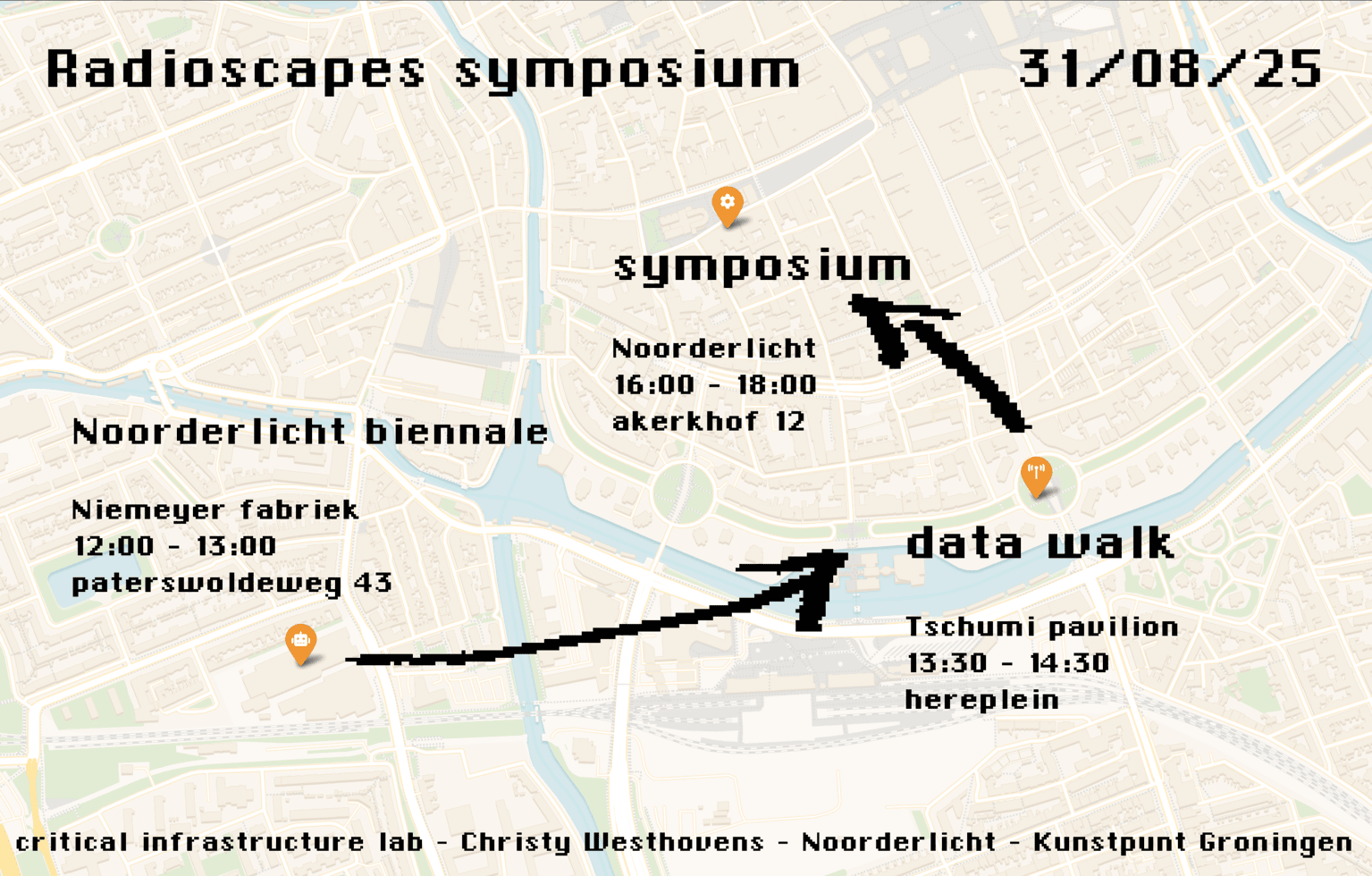
radioscapes symposium [31/08/25]
Photography by Sven Sleur
description
We constantly move through a sea of radio signals. Wi-Fi, Bluetooth, cell towers and satellites form an invisible landscape that permeates our everyday lives. These electromagnetic waves shape how we communicate, move and live together — and yet, we never see them.
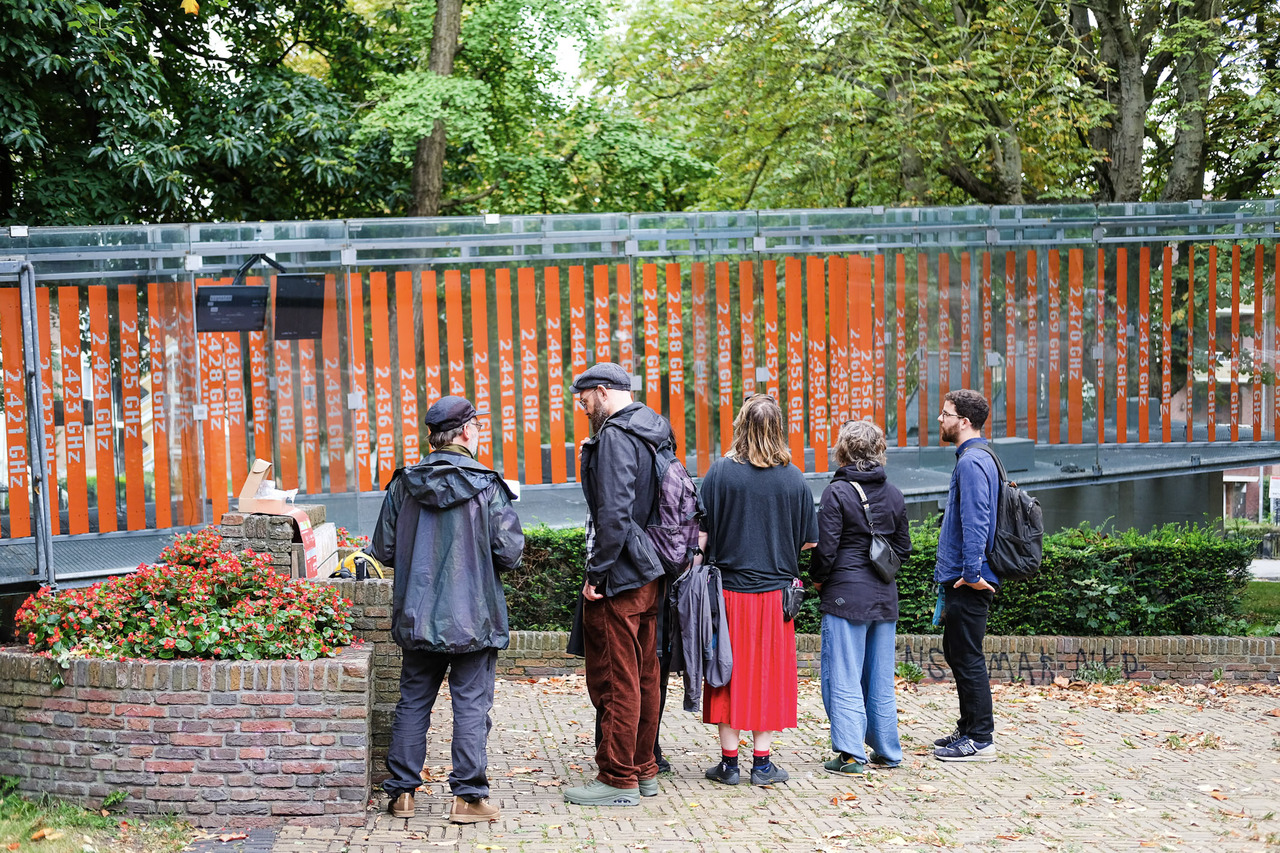
With Signals of you, her installation at the Tschumipavilion, chris_ty makes this hidden network tangible. The orange panels respond to Bluetooth signals emitted by our devices, revealing how we continuously broadcast digital traces. The pavilion becomes an archive of daily presence, showing how infrastructure and behaviour together shape urban space.
The Radioscape Symposium offers a deeper exploration of this work. Bringing together artists, scholars and critical voices, we will reflect on how radio signals construct public space. What role do we play in these digital environments? Who has access to these invisible layers, and who is excluded? And what does it mean to render such ubiquitous but hidden signals visible?
Link to the programme >> critical infrastructure lab
radioscapes symposium, a summary of the day
A report by Maxigas, critical infrastructure lab
It was a very nice field day, with productive discussions, great vibes and engagement
with the audience. We brought together seven artists and scholars to tour Groningen, the biennale, the Signals of You installation, and to discuss their experiences
and the implications of the works at a symposium in the evening. About a dozen
participants from the general public joined the tour, mostly from the MADtech pro-
gramme at RUG and from the hacklab in Amsterdam. The programme integrated
into the cultural infrastructure of the city, touching on Niemeyer Fabriek, Kunstpunt’s Tschumipaviljoen, the Groninger Museum, and Noorderlicht.
After browsing the exhibition at the Niemeyer Fabriek, participants met for a guided
tour of the Signals of You installation at Hereplein, where chris_ty introduced and explained her work, and answered questions from panelists and the audience. We got
familiar with the electro-magnetic spectrum and how it is used by various technologies and users, from GPS satellites to the marifoon conversations that coordinate
boat movements. This allowed us to situate the frequencies and technologies used
in chris_ty’s installation in the broader landscape of radiowaves (what we call the radioscape). Signals of You monitors Bluetooth devices that use the 2.402 GHz to 2.48
GHz frequency range. There were many more questions and observations about
how the installation works and how it interacts into its surroundings, including the
architecture of the Hereplein, the rhythm of public transport and the passengers
and pedestrians around it.
Photography by Sven Sleur
The co-principal investigators of the critical infrastructure lab [Maxigas and Niels ten Oever] then facilitated a little data walk, demonstrating the methodologies and the types of insights that can
be gained by sustained attention to public digital infrastructures that are deployed
in the public space. This includes visual observation techniques and tools such as
maps and apps, as well as engaging with infrastructure operators who are encountered on the streets while performing their duties. This time, such an infrastructure
operator was the bridge watcher, who explained that workers use VHF radios on private channels to talk to each other, while boat captains can request the bridges to
open on Channel 9 (around 156.450 MHz).
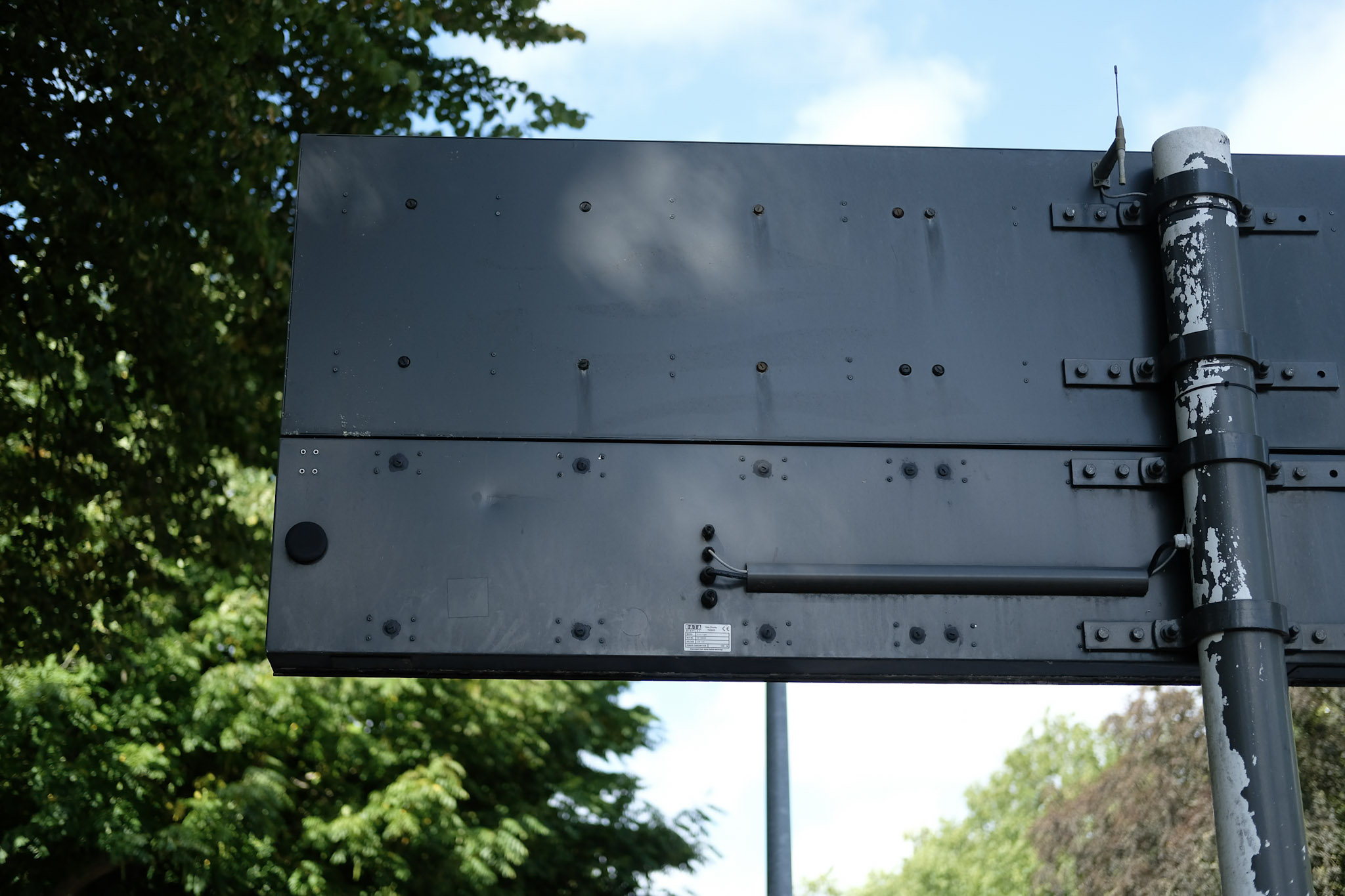
We also observed and discussed a number of systems found at the head of the bridge, including car number plate recognition cameras, traffic information systems, smart meter monitoring stations, and
telecommunications masts. Some of the information sources that we relied on to
learn more about these devices have been the mobile apps such as Architecture of
Radio and OpenSignal, the open data map of sensors published by the Groningen
municipality, and the national antenna database. For example, the latter could
help us to identify the KPN mobile phone mast where we received 4G service from
while standing on the bridge. It was on the top of the building just opposite the
bridge, but only visible if we walked back towards the square a bit. Through these
exercises, participants could get a sense of where they are located in terms of the infrastructural entanglements produced by digital infrastructures in the public space,
and spread over the radioscape in which they are immersed all the time.
Photography by Sven Sleur
A lunch at the Groningen Museum followed, where we could take stock of the conclusions of the walk and prepare for the next point on the agenda, the symposium.
At Akerhof 12 we had about 20 people, including chris_ty and six panelists. The symposium opened with chris_ty’s introduction, letting people in on how the installation came about and the questions she faced while producing and presenting the
artwork. Panelists gave their input on their own interpretation of Signals of You
and then reacted to each others ideas. All were impressed by the work and saw
far-reaching implications, including thematising the routine signal emissions of the
users of consumer electronics devices, and making everyday life in the normally in-
visible electro-magnetic spectrum visible so that what happens there can be prob-
lematised, debated and governed more democratically. The exchange of ideas converged on the electro-magnetic spectrum as a public space that needs more attention in terms of its political implications, with differing views on what form such
democratic engagement with the spectrum should take. For example, the idea of
“open spectrum” was hotly debated. It is the idea that anyone can use the spectrum
for any purpose as long as they check for potential interference before they transmit, a possibility brought about by recent innovations in radio technologies such
as spread spectrum approaches, software defined radios, and smart spectrum management algorithms. Another aspect that was taken up by the panelists, based on
an intervention from the audience, was the legal question of informed consent and
reasonable expectations of privacy. While these are defined in data protection and
consumer protection regulations (for example by the GDPR directive of the EU), it
is hard to have informed consent or reasonable expectation of privacy if users may
even be aware of their signal emissions and the electro-magnetic leakage from their
devices. Therefore, chris_ty’s work was framed as contributing to bringing these de-
bates about the utilization of communication standards in the public space into the
public consciousness and the arena of democratic debates about technology governance. Finally, participants agreed on the way that chris_ty’s Signals of You artwork
connects to the longer tradition of photography: it is about taking a snapshot of the
electro-magnetic field, recording emissions at a particular location and a particular
moment, just not in the scope of the invisible light, but of a different envelope of
the spectrum.
The last part of the roundtable was about engaging with the audience, who we found
out to be mostly university students at the beginning of their studies. They so far
considered technology as a way to give form to their work, but not as a research
instrument that can open up the possibility of observations and presentations of
invisible worlds. The conversation then meandered on the role and mission of media art in the contemporary historical moment, and its broader societal functions in
terms of democratic technology governance and anti-capitalist resistance to hegemonic infrastructural ideologies. It was clear that students have a lot of consequential questions to take up in their studies and future works, questions that currently
practicing professionals are still grappling with.
The evening ended with a borrel, including couscous salad which we prepared the
day before and drinks from the supermarket. We had really positive feedback from
both panelists and participants, who were happy with the experience and inspired
by the conversations and observations during this radiant day. We are again thankful
to Noorderlicht for the funding and venue and in particular to Sven for documenting
the event on photographs that we can use for reporting.

thank you <3
A heartfelt thank you to the participants and speakers who made it into a radiant day!A special thanks to Arthur Elsenaar, David Gauthier, Gabriel Pereira, Juli Laczkó, Maxigas and Niels ten Oever for their input. And to Sven Sleur and Noorderlicht for facilitating and documenting this event :)
_Signals of you_ was commissioned by Noorderlicht and Kunstpunt as part of the Noorderlicht Biennale 2025. The _radioscapes symposium_ was organised in collaboration with the critical infrastructure lab and Noorderlicht.